


Every new object, clearly seen, opens a new organ of perception in us.
Johann Wolfgang von Goethe
Warm 2026 greetings to my subscribers!
On Tuesday, December 16th of 2024 I made a 20-minute presentation at the “100 Years Rudolf Steiner” conference organized by Harvard Divinity School on research I have been conducting on Rudolf Steiner’s view of race and ethnic culture and its relevance for our time.
As you can imagine, bringing this far-reaching research into a 20-minute time slot was rather challenging and I felt I had to leave out a lot of things that would have brought more nuance to what clearly proved to be, for some anyway, a highly provocative presentation.
For these reasons, in the two videos below, I have decided to offer a significantly expanded version of my Harvard presentation.
While the 20-minute version of my presentation was recorded, unfortunately that recording is temporarily unavailable. My understanding is that the recordings of all the different panels from the conference will soon be posted on the YouTube channel of Harvard Divinity School which can be found here. I suggest you keep checking that website, and I will let my readers know via a substack note as soon as I see that they are available.
As I prepare to publish these videos on this highly controversial topic, I wish to address in writing what is perhaps the most likely and unfortunate misunderstanding that could arise from this effort, namely that my attempt to bring nuance to Rudolf Steiner’s view of race is seen as a defense of his seeming racist viewpoints and remarks.
As I see it, such a perspective succumbs to the polarizing tendencies of our cultural moment, which tends to view any effort to truly understand something or someone as the same as agreeing with that person or thing. Just think of how, at this moment, any critic of the recent attacks by the US on Venezuela can be labeled as a supporter of the current regime in Venezuela. This kind of black and white thinking is the death of both democracy and of enlightened discourse of all kinds.
Using the laws of dynamic polarity, however, which I introduce in these videos, we can chart instead a healing or middle path, as follows:
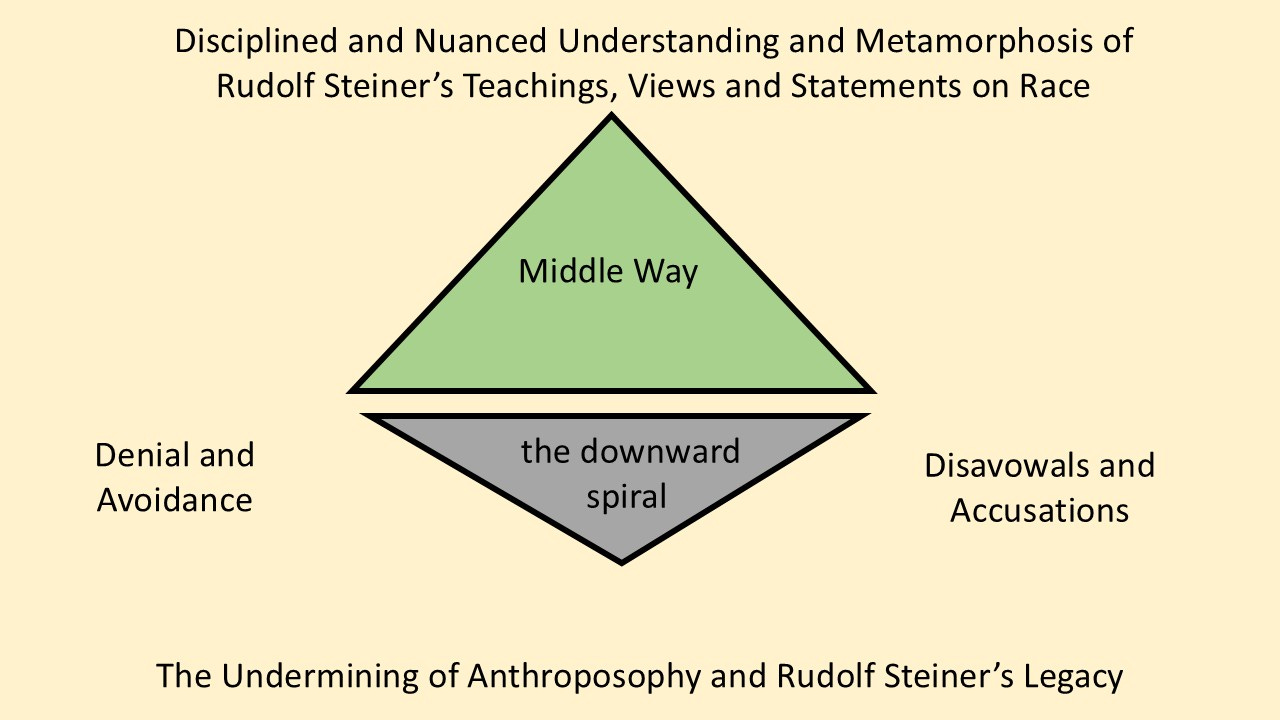
Here I seek to show how both the denial of Rudolf Steiner’s seeming racist views (or the unwillingness to honestly examine or acknowledge these views), and the disavowal of those views without a proper effort toward a deeper understanding of them (or the knee jerk accusation that Rudolf Steiner was a racist), can both be seen as one-sided responses.
What I propose instead—and what I seek to embark upon in these presentations—is a sensitive, nuanced exploration of these aspects of Steiner’s legacy using the phenomenological disciplines that lay at the heart of spiritual science itself. As I understand it, this approach is also a basic principle of sound hermeneutics as articulated by William Dilthey:
An author or thinker can only be understood by reconstructing the life context and experiential world in which they articulated their ideas.
For those who might be interested in delving more deeply into this topic, I am considering offering an online short course this Spring. If you might be interested in being part of such a course, please let me know by clicking on this link.
Part I:
Part II:
Jeff, I would like to respond to some aspects of an earlier post of yours.
A fundamental question you were raising seems to be, how should people who find great value in Rudolf Steiner’s work respond to statements he made that we find to be false or biased in some fashion. By “respond” I mean not so much how should we respond internally, but externally, such as the example you gave of parents in a Waldorf school coming upon these comments and then approaching us. Or how should the Anthroposophical Society, for example, respond.
This is complex territory because of the incredible amount of rigor and nuance that I believe is necessary to even be sure we understand Rudolf Steiner. Be that as it may, for the purposes of furthering our discussion, here are seven statements that I think could perhaps guide us in responding responsibly on these matters. I would be very interested in what you all think of these. I have only drafted these today and am putting them out simply to advance the conversation, not because I consider them ready to be shared widely as a recommendation.
1. Anthroposophy, as a spiritual teaching, is in no way racist (by any reasonable definition of that word). It is and has been, rather, a major force in combatting racism and fostering human harmony all around the world—the same can be said of the many daughter movements flowing out of anthroposophy, such as Waldorf education, biodynamic agriculture, anthroposophical medicine, etc., etc.
2. Individual anthroposophists are all flawed human beings, however, who often mix their own biases and limited life experiences up with their work on behalf of anthroposophy. This is the unavoidable reality of a modern spiritual movement, which can only be addressed through an ongoing commitment to spiritual growth and development by each individual involved.
3. Rudolf Steiner himself was also a flawed human being and sometimes his writings and words bring to expression his own lack of experience, biases, or historical limitations. It is thus up to each individual to continually sift through the work of Rudof Steiner to find what is future bearing or true for them and to leave behind what is not.
4. Since anthroposophy is not a dogma or religion, this methodology has always been the case, with all of Steiner’s teachings and practical initiatives. And since no one can do this work for another individual, it is not the job of the Anthroposophical Society or any other organizational body to make an official statement or declaration disavowing one lecture, statement, concept or another. People must do this work for themselves.
5. What can and perhaps should be done is to simply acknowledge that Rudolf Steiner was himself a flawed human being, and by his own admission, subject to potential errors in his spiritual research. One could perhaps also acknowledge that there are certain statements made by him that many students of anthroposophy find to be troubling, and/or out of alignment with his primary teachings.
6. Most people who have studied this question in a rigorous fashion (including the Dutch commission), have come to the conclusion that while Rudolf Steiner certainly expresses biases on occasion, there is no evidence of ill will on his part toward people of color, nor any semblance of a doctrine of white supremacy in his teachings on race and culture.
7. From this standpoint, it would perhaps also be reasonable for the Anthroposophical Society and perhaps other key institutions to put out a statement unequivocally rejecting any attempt to interpret Rudolf Steiner’s work or statements as expressing some form of white supremacy.
Colin, I am very moved by your words, it is so profound what you have shared...you are bringing out something so very important and so easy to miss unless one is aware of the fuller picture Steiner gives of the white race and of the western inclining folk souls…which is the fact that, just as you say, they most embody the destiny of the prodigal son.
This creates the challenging, tragic, two-fold destiny of the West, one of great cultural advances along with unspeakable moral failures and intellectual blindness. The material leaning peoples and cultures of the west are thus also those most in need of a manifestation of God reaching right down to the physical, and into the forces of the earthly personality, as happened through the Christ event.
It is this perspective that underlies but is very easy to miss in 174b and throughout much of Steiner. Here for example is a little-known verse of Steiner from his earlier years that most people are unaware of, in which he states the tragedy in stronger terms, though still somewhat veiled:
A new dawning of the white race
Will manifest itself in earthly spheres
Only when the sages of this race
Feel the soul’s bond with the spirit,
And in them will take effect
A feeling of the shame
That blackens souls
When they seek to comprehend
Man’s being through material senses.
Later in his life he will point out that the sign of any genuine encounter with etheric Christ is that the whole soul will be permeated by the most profound sense of shame. Clearly, Rudolf Steiner himself had this experience.
As I see it, Jeff, we need to fashion a whole new narrative about race and culture that draws on Steiner’s eagle, lion and bull teaching but that breaks wholly new ground. One could also think of eagle, lion and bull as the blossom, leaf and root of a plant—the plant of anthroposophy—which is now entering the seed stage during which it must be either reborn in a new form or become a historical relic. I realize it may look like I am simply trying to defend or nuance Steiner within a relatively small circle, but I see this as simply the preliminary, soil tilling work necessary to receive the seed of a whole new inspiration coming from the future rather than from the past.
Just as through Pentecost the disciples gained a new power of speech able to bring the mystery of Christ experienced by the 12 to all people, so you could say we are entering the Pentecostal phase of anthroposophy and of esoteric Christianity more broadly speaking. If we do the right preparatory work, as I see it, through grace, some of us can begin to manifest this new power of the spirit and of language that will be able to reach any and every human being. I suspect many of us have glimmers of the emergence of these new capacities.
I will share more in the coming days. Again, I am so grateful for this dialogue.